1 / 12
Research Talk

Urban Breathing

A Hybrid AI Digital Twin for
Hyperlocal Air Quality in Greater Manchester
Congbo Song
National Centre for Atmospheric Science, The University of Manchester
The Problem

Air quality decisions need
street-level data — we give them city-average maps

Current models operate at 1–10 km resolution. A child's walk to school passes through canyons, junctions, bus stops — each with different NO₂ levels.

Annual-average maps miss the hourly dynamics: rush-hour peaks, weekend dips, weather-driven episodes.

25 m

Resolution needed to resolve
street canyons & traffic corridors

The Challenge

Physics is exact — but expensive

WRF-Chem (Physics)

  • 3 nested domains: 27 km → 9 km → 1 km
  • MESO-SUITE chemistry: MOZART-MOSAIC
  • 209 chemical species, 4-bin aerosol
  • 1 day simulation: 2–3 hours on 64 cores
  • GPU memory & numerical stability limits downscaling
vs

Diffusion Model (AI)

  • Learns to map low-res physics → 25 m street-level
  • Physics-informed: respects advection, dispersion
  • 1 prediction: seconds on 1 GPU
  • But needs WRF-Chem fields as input
  • Training data: the expensive bottleneck
The Idea

Two brains, one digital twin

Coarse Brain

WRF-Chem on HPC

First-principles meteorology & chemistry
1 km resolution · 64 CPU cores
Teaches the AI what physics looks like

Fast Brain

Physics-Informed Diffusion

Super-resolves to 25 m street level
1 GPU · seconds per prediction
Deployed on cloud or edge

Output

Hourly Street-Level AQ

NO₂ · O₃ · PM₂.₅
25 m across Greater Manchester
On-demand, anytime

The physics model teaches — the AI generalises — the city breathes at street level

System Architecture

How the hybrid pipeline works

CSF3 HPC

WRF-Chem 3-domain nested runs

64 cores · 2–3 h/day
1 km output fields
met + chem + aerosol

Training Pipeline

Low-res WRF fields → 25 m surrogate truth

Cloud GPU (A100) · weeks
Physics-informed loss
Advection & dispersion constraints

Inference

On-demand 25 m predictions

1 GPU · seconds
WRF coarse as conditional input
Hourly NO₂, O₃, PM₂.₅

25 m
Output Resolution
209
Chemical Species
~10⁴×
Speed-up Factor
Method

Physics-informed diffusion: not just a pixel guesser

Key insight: the diffusion model doesn't replace physics — it compresses it. Every prediction is traceable back to a WRF-Chem simulation.

Step 1: Activity

High-Resolution Traffic Simulation

Agent-based simulation of vehicle movements at 25 m resolution

Step 2: Sources

Dynamic Street-Level Emissions

Translating vehicle activity into NOₓ emissions

Step 3: Dispersion

Pollutant Concentrations (Diffusion Output)
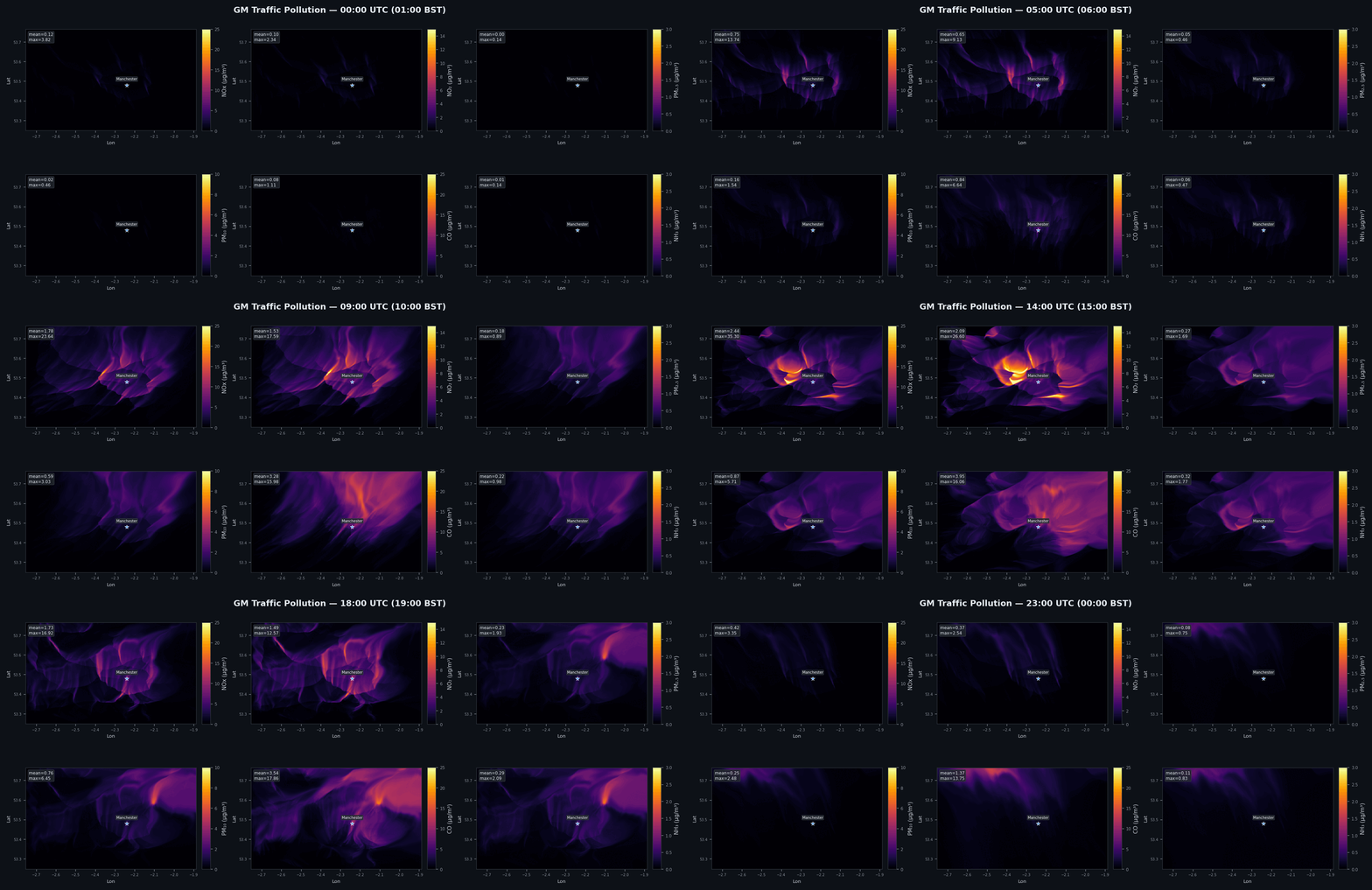
Physics-informed diffusion mapping 1 km WRF-Chem to 25 m NO₂ concentrations

Where We Are

Progress so far

✓ Completed

  • WRF-Chem v4.8 MOZART-MOSAIC configured for GM
  • 3-domain nesting: 27 km → 9 km → 1 km
  • NAEI emissions processing pipeline
  • CAMS boundary conditions integration
  • PCNO diffusion model framework
  • GPU training pipeline on CSF3 A100

◎ In Progress

  • MOSAIC aerosol simulation
  • Full WRF-Chem benchmark run (3-h spin-up)
  • Training dataset generation (seasonal variation)
  • Physics-informed loss function validation

○ Next

  • 25 m diffusion model training
  • Observation validation (AURN + sensors)
  • Policy scenario experiments
Impact

From annual averages to hourly, street-level action

🚗

Traffic Policy

Test Clean Air Zone scenarios, speed limits, and Low Traffic Neighbourhoods (LTNs) — see NO₂ changes at every junction in seconds.

🏫

Community & Active Travel Exposure

Map hourly PM₂.₅ at school gates across Manchester. Identify high-exposure drop-off times and safer walking routes

🏥

Public Health

Epidemiological studies need exposure at where people actually are, not at the nearest 10 km grid point. 25 m changes everything

Greater Manchester moves from estimating exposure to knowing it

Thank you

Urban Breathing

Physics teaches, AI scales, the city breathes at street level

Questions & discussion welcome